What is a somatic therapist?
You can understand your past and still feel your body react like it’s happening now.
You can know where your anxiety started and still feel your chest tighten in relationships.
You can talk about childhood wounds and still overwork, withdraw, or shut down before you consciously choose to.
That’s because healing doesn’t live only in insight. It lives in the nervous system.
A somatic therapist works with how your body has organized itself around experience. Long before you had language, your nervous system was learning: what is safe, what is dangerous, how much of me is allowed here.
Those early experiences shape perception. Perception shapes beliefs. Beliefs shape how your body responds automatically.
Somatic therapy helps you work at that level, where patterns are embodied, not just understood. Instead of asking only, “Why am I like this?” we begin asking:
What is my body doing right now? What does it expect to happen? What did it learn about the world?
From there, change becomes possible.
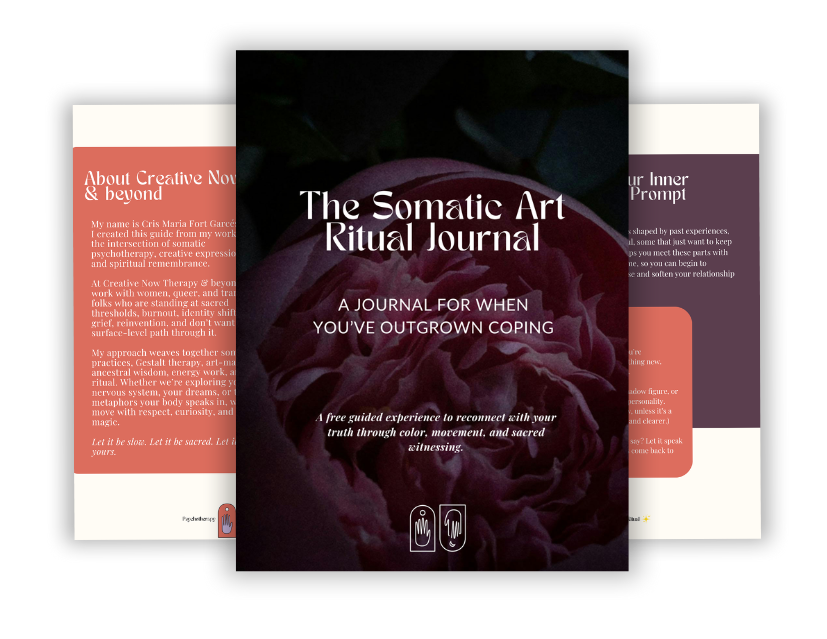
I am Cristina Maria Fort Garcés, a somatic guide working at the intersection of therapy, spiritual practices (astrology & tarot), and nervous system wisdom. My work centers on
somatic psychotherapy and energy coaching, supporting people who feel deeply, tend to hold space for others, and are ready to heal at the level where patterns actually live. If you are a healer, therapist, creative, or space holder carrying long-term stress or feeling disconnected from your body, you may want to explore somatic therapy for healers as a path of integration rather than self-management.

What somatic therapy focuses on and why the body matters
Somatic therapy focuses on how experience lives in the body.
When something overwhelming happens, especially early in life, your system adapts. Muscles tighten. Breath shortens. Awareness narrows. You may become hyper-alert, emotionally shut down, overly responsible, or disconnected from your needs.
These responses are not flaws. They are intelligent survival strategies.
In this kind of work, we slow down enough to understand what’s really happening beneath the surface. For example, you might come in saying, “I get anxious in relationships.” That’s the surface experience.
But when we look more closely, we might discover that underneath the anxiety is something more vulnerable, maybe a deep need to feel safe, chosen, supported, or accepted. A need that didn’t feel steady at some point in your life.
And beneath that is something even quieter: the expectation your body formed about how relationships work. Maybe your system learned: “It’s safer not to need anyone.” “If I relax, I’ll be disappointed.” “I have to work hard to keep connection.”
Those expectations don’t usually show up as thoughts. They show up as tension in your chest. As pulling away. As over-explaining. As bracing. Your body reacts as if those old rules are still true, even when your adult mind knows your life is different now.
Somatic therapy helps you notice those old rules in real time. Once they’re visible, your nervous system can slowly begin to learn something new.
What does a somatic therapist do?
Helps you tune into the body
A somatic therapist guides you into noticing what is happening in real time.
You might notice tightness in your shoulders when you talk about work. A drop in your energy when you describe a conflict. An urge to smile when something painful is mentioned.
Instead of moving past these signals, we slow down. The body often tells the truth before the mind catches up.
This awareness is not about analyzing yourself. It’s about developing a relationship with your internal experience, learning to recognize tension, bracing, shutting down, or activation as information.
Over time, this increases choice. You begin to recognize a reaction as it starts rather than after it’s taken over.
Uses somatic therapy techniques
Somatic therapy techniques are often subtle. We might work with breath, grounding, small movements, or shifts in posture. We may slow a moment down so you can feel what happens in your body when you set a boundary, receive support, or speak honestly.
The goal is not dramatic emotional release. It’s capacity. If your system becomes activated, we don’t push through it. We help it regulate. If you feel numb, we approach gently rather than forcing intensity.
Sometimes we also look at patterns that show up between us in the room. For example, if you start minimizing your needs or taking care of me instead of yourself, we might pause and explore that pattern together.
Bringing awareness to these relational reflexes helps them become flexible rather than automatic.
Integrates psychology and physiology
Emotional experience and physiology are inseparable. Anxiety often shows up as shallow breathing or tightness in the chest. Shame may feel like heat in the face or a collapse in posture.
Grief may register as heaviness or pressure.
Somatic therapy works at the interface between thoughts and bodily states. Rather than trying to override your body with positive thinking, we help your nervous system experience something different, safety, support, and completion.
When that happens, insight becomes embodied change.

How somatic therapy heals trauma
Trauma is not only what happened. It’s what your body had to do to survive.
When overwhelming experiences interrupt your natural stress response, energy can remain stuck. The body stays braced, guarded, or shut down long after the event is over. Somatic therapy helps your system complete what was interrupted.
Instead of reliving events in detail, we work in present-moment awareness. We notice activation in manageable doses. We build tolerance slowly. We allow the nervous system to experience safety without forcing it.
Over time, the body learns that it no longer has to live in constant protection. Healing here is often quiet. Breathing becomes easier. Boundaries feel steadier. Support becomes tolerable. Closeness feels less threatening.
These shifts may seem small, but they reflect deep reorganization.
What happens in a somatic therapy session?
The beginning of safety and grounding
Sessions begin with establishing safety. Not assumed. Built. We may orient to the room. Notice the chair supporting you. Feel your feet on the ground. Track your breath.
The nervous system responds to experience more than explanation. Before exploring anything difficult, we make sure your body has access to steadiness.
Somatic experiencing in practice
As we talk, we slow down moments that feel charged.
You might notice:
Your breath changing when you describe conflict. Your body tightens when you talk about asking for help. Your energy dropping when you speak about feeling unseen.
Instead of moving quickly past these shifts, we stay with them gently. You learn to recognize your own internal signals, not as something to fix, but as something to understand.
Release happens through awareness, regulation, and integration, not force.
Integration and reflection
Toward the end of a session, we take time to notice what changed.
Did your posture shift?
Did your breathing deepen?
Did something feel different in your body?
Integration allows the nervous system to register new experiences. This helps change stabilize rather than disappear when stress returns.
Who can benefit from somatic therapy?
Somatic therapy can support anyone carrying unresolved stress or trauma, especially if insight alone hasn’t created lasting change.
It may be helpful for:
PTSD or childhood trauma
Anxiety, panic, or chronic stress
Depression or emotional numbness
Burnout and over-functioning
Birth or postpartum trauma
Chronic relational patterns
It can be particularly powerful for therapists, healers, and helpers who are skilled at holding others but struggle to feel supported themselves.
If you are strong in understanding but tired in your body, this work may be for you.

Types of somatic therapy
Somatic experiencing
Focuses on restoring the nervous system’s natural rhythm between activation and rest by working in small, contained increments.
Sensorimotor psychotherapy
Blends body awareness, emotional processing, and relational exploration to address trauma patterns.
Hakomi method
A mindfulness-based, body-centered approach that studies present-moment experience to uncover and gently shift core beliefs formed early in life.
Movement and dance therapy
Uses physical movement and creative expression to process and release stored emotional experience.
Somatic therapy vs traditional talk therapy
Traditional talk therapy focuses on reflection, understanding, and cognitive insight.
Somatic therapy begins with lived experience. Both are valuable. Talk therapy helps you understand your patterns. Somatic therapy helps your body update them.
For many people, especially those with trauma histories, lasting change requires working at both levels.
Somatic exercises you can try at home
Grounding through the senses
Name five things you can see.
Four things you can feel.
Three things you can hear.
Two things you can smell.
One thing you can taste.
This helps your nervous system orient to the present rather than the past.
Breath reset
Breathing is one of the most direct ways to communicate safety to your nervous system.
Option 1: Lengthen the exhale (gentlest + most accessible)
Inhale through your nose for 4.
Exhale slowly for 6–8.
Repeat for 1–3 minutes, letting the exhale do most of the work.
Why this helps:
A longer exhale activates the parasympathetic nervous system through the vagus nerve. This signals safety and helps the body settle out of fight-or-flight. It is one of the most reliable ways to calm the nervous system without forcing relaxation.
Option 2: Box breathing (for when your system feels stable enough)
Inhale for 4.
Hold for 4.
Exhale for 4.
Hold for 4.
Repeat for several rounds.
Why this helps:
Box breathing creates rhythmic predictability. That steady rhythm can increase regulation and focus. If holding the breath feels activating or uncomfortable, return to simply slowing the exhale instead.
Gentle movement for release
Stretch slowly. Shake your arms. Walk and notice the sensation in your feet.
Let movement process what words cannot.
Healing from the inside out
Healing is not about fixing yourself.
It is about helping your nervous system experience safety where it once expected danger.
Your body is not broken. It is protective. It adapted in intelligent ways.
Somatic therapy offers a space to listen to those adaptations with care — and gradually build a different internal world, one where support, steadiness, and connection are possible.
Change here is not forced.
It is felt.
If you are a healer or space holder longing for integration rather than another tool, somatic therapy for healers offers a grounded, embodied space to return home to yourself.

Hello, I’m Cris Maria Fort Garcés
Therapy & Beyond for Spiritual Beings. Clinically trained. Mystically tuned.