Trauma Release Exercises: 6 Step by Step Practices from a Somatic Psychotherapist in New York
Disclaimer: This blog is for educational purposes only and does not constitute therapy or replace professional care. If you have a significant trauma history, please consult a licensed professional before practicing these exercises on your own.
Trauma release exercises can be helpful when your body feels like it is still carrying something long after an experience has passed. You understand what happened. You have processed it in therapy, journaled about it, pulled cards on it, talked about it with your best friend at 11pm. And still. The chest tightens at the same moments. The shoulders do not come down. The nervous system does not fully settle.
This is not a failure of insight. It is not a failure of your spiritual practice. It is because trauma is not only held in the mind. It is held in the body, in patterns of contraction, protection, and activation that do not resolve through understanding alone. Your body learned to brace. And until it learns something different, it will keep bracing, regardless of how much you know about why.
If you are new to this work, it may help to first understand what a somatic therapist is and how body-based healing works, especially if you have only experienced traditional talk therapy before. This approach works differently because it includes your nervous system as part of the healing process, not just your story about what happened.
I am Cristina Maria Fort Garcés, a somatic therapist and energy coach working at the intersection of clinical depth and mystical practice. My work centers on somatic psychotherapy and energy coaching, supporting people who feel deeply, hold space for others, and are ready to heal at the level where patterns actually live. If you are a healer, therapist, creative, or space holder carrying long-term stress or feeling disconnected from your body, you may want to explore somatic therapy as a path of integration rather than self-management.
What are trauma release exercises?
Trauma release exercises are body-based practices that help your system move out of survival states and into regulation. They are not about forcing something intense to happen or manufacturing a breakthrough. They are about helping your body complete responses that were interrupted, sometimes years ago, sometimes decades ago, sometimes in moments so ordinary you would not even call them traumatic but your nervous system catalogued them anyway.
This is why simple practices often work best. They allow your system to feel safe enough to shift instead of pushing it into overwhelm. In the same way that a shamanic journey works by moving slowly through images and sensation rather than confronting the wound directly, these exercises approach the nervous system sideways. Through the breath. Through gentle movement. Through the felt sense of your own body in the present moment.
If you want more foundational practices before going deeper, you can explore somatic exercises for anxiety and trauma, where I share beginner-friendly tools that support regulation first. Stabilization before depth. Always.
6 trauma release exercises for your nervous system
Start slowly.
Trauma work is not about doing more. It is about doing what your nervous system can actually hold right now, not what you think it should be able to hold, not what worked for someone else. If something feels overwhelming, pause. Come back to the room, your breath, your feet on the floor. The practice is not more important than your safety inside it.
If you are still learning how to regulate your system, it may help to read more about
nervous system regulation so you understand how safety and stabilization come before deeper work. That sequence is not optional. It is the whole thing.
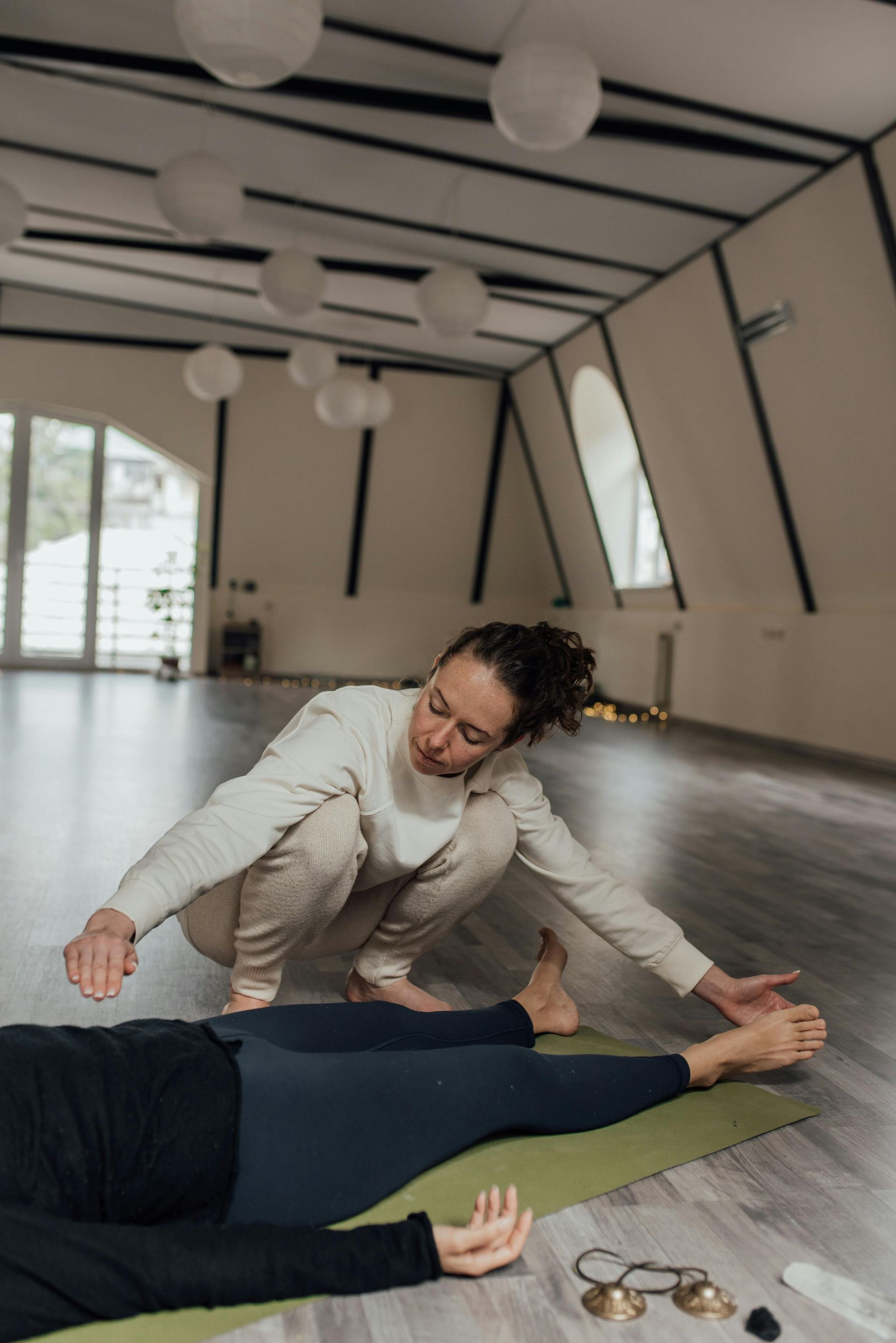
1. Orienting to the room
This is one of the simplest and most effective trauma release exercises because it does something profound with very little effort. It helps your body recognize that you are here, now, not there, then.
In Hakomi and somatic work, we call this orienting. In animistic practice, it is something older than that. It is the act of making contact with the living world around you, acknowledging that you are embedded in a specific place, a specific moment, surrounded by specific things that are real and present and not threatening. Your nervous system responds to this information. It just needs you to actually deliver it.
Step by step
Sit or stand comfortably. Let your eyes move slowly around the room, not scanning for threat but actually landing on things. Notice shapes, colors, textures, objects. Feel your feet on the ground as you do this. Stay here for a full minute. Let your gaze be soft, curious, unhurried.
You are giving your nervous system new data: you are here, now, and not in the past.
2. Extended exhale breathing
Your breath is one of the most direct access points to your nervous system. Not because breathing is magic, but because the exhale activates the parasympathetic branch, the part of your system that signals rest, safety, and digestion. Every long exhale is a message to your body that the threat has passed.
In breathwork traditions, the exhale is considered the letting go breath, the surrender breath. You do not have to believe that metaphysically for it to work physiologically. Though in my experience, the two are not as separate as we tend to think.
Step by step
Place one hand on your chest and one on your ribs or belly. Inhale gently through the nose. Exhale slowly through the mouth, letting the exhale be slightly longer than the inhale. Do not force it. Do not perform it. Just let it be a little longer than usual.
Repeat for several rounds. Notice what shifts.
3. Body scan with gentle awareness
Most people who carry trauma have learned, without knowing it, to vacate certain parts of their body. The chest goes numb. The pelvis disappears. The throat becomes a wall. This exercise is not about forcing your way back in. It is about knocking gently and seeing who answers.
Step by step
Sit or lie down somewhere you feel relatively safe. Slowly bring your attention to different parts of your body, starting from your feet and moving upward. Not to fix anything. Just to notice what is there.
If you find an area of tension or discomfort, stay with it briefly and with curiosity, not correction. Then move your attention to a part of your body that feels more neutral. This back and forth, between activation and neutrality, is called pendulation. It is how your system learns that it can touch difficulty and still come back to safety. That is not a small thing. That is the whole arc of healing.

4. Self holding and tapping
There is something ancient about holding yourself. Every tradition has a version of it. The crossed arms. The hand over the heart. The rocking that humans do when they are in pain without anyone telling them to. Your body already knows this gesture. This exercise just makes it intentional.
Step by step
Cross your arms over your chest, placing your hands on your shoulders or upper arms. Apply gentle pressure, enough to feel held but not restricted. Then begin a slow alternating tap from one side to the other. Left, right, left, right. Keep it steady and soft.
Stay here for as long as feels supportive. Notice if your breath changes. Notice if anything softens.
5. Pendulation between tension and safety
This is one of the core techniques in somatic work and one of the most elegant. It is based on a simple truth: your nervous system does not need you to eliminate difficulty. It needs you to prove that difficulty is not permanent. That activation is survivable. That you can feel it and still come back.
This is also the principle underlying Tarot work done somatically. You approach the card that carries the charge, you feel what it brings up in your body, and then you return to ground. The card does not swallow you. You move toward it and you come back. Over and over until the charge begins to metabolize.
Step by step
Notice one area of tension in your body. Stay with it briefly, maybe ten to fifteen seconds. Then shift your attention deliberately to a place that feels more neutral or grounded, your hands, your feet, your breath.
Stay in the neutral place longer than you stayed in the tension. Then move back. Let the rhythm be slow and unhurried. You are teaching your system something it may never have been taught: that it can touch the difficult and return. Every time it does, something updates.
6. Gentle shaking and discharge
Animals shake after threat. It is one of the most natural things a body can do to complete a stress response. Humans learned to stop doing it, to hold still, to perform composure. This exercise is an invitation to remember what your body already knows.
You do not need to manufacture intensity here. The gentlest shake is enough. The body does not need to be forced into discharge. It needs permission.
Step by step
Stand with soft knees. Begin by shaking your hands lightly, as if you are trying to air dry them. Let the movement travel up through your arms if it wants to. Keep your jaw soft. Keep your breath moving.
After one to two minutes, stop. Stand still. Notice what has changed. Where does your body feel different? What has loosened? Return to grounding if you need to.

How to choose the right exercise
Not every exercise is right for every moment, and learning to read what your body is actually asking for is itself part of the work.
- If you feel overwhelmed or flooded, start with orienting or self holding
- If you feel tense and contracted, try extended exhale breathing or gentle shaking
- If you feel disconnected or numb, start with the body scan and move slowly
- If you want a wider foundation of tools before going deeper, revisit
- somatic exercises for anxiety and trauma
Trust what your body leans toward. That preference is information, not accident.
Are you ready to approach trauma work in a different way?
If something in this resonated, it may be because your body is asking for a different kind of support. Not more pressure. Not more coping strategies to layer on top of a nervous system that is already exhausted. Something slower. Something that actually goes to where the pattern lives.
The exercises in this guide are real and they matter. But they are also a beginning, not a destination. Certain patterns need a container. A real relationship. A trained presence that can track what is happening in your body in real time and stay steady while you do the work you have been circling for years.
If you are in New York and you are ready to explore trauma work in a way that includes your body, your nervous system, your spiritual tools, and the deeper mythic story underneath all of it, this may be the space where things begin to shift in a different way.
Book a consultation or explore
therapy in Kingston, New York to find out what working together could look like.

Hello, I’m Cris Maria Fort Garcés
Therapy & Beyond for Spiritual Beings. Clinically trained. Mystically tuned.