

Somatic Trauma Therapy: How the Body Heals What the Mind Cannot Reach Alone

Cristina Maria Fort Garcés, LCAT, ATR-BC, CPC • October 29, 2026

You know the story of what happened to you well. You may have told it in therapy, journaled it, traced it back through your family, and still noticed that the knowing does not always change the feeling. That is not because you are broken or damaged. That is your body saying, "I still need something different".

Somatic trauma therapy works with that different layer. Not just the story, but the nervous system, the contraction, the bracing, the freeze, the collapse, the part of you that still reacts even when your mind knows you are safe.

In case you're new here, I'm Cristina Maria Fort Garcés, a somatic therapist and spiritual guide supporting deep-feeling humans through the trauma that lives in the body and the soul-level dimensions that clinical approaches alone do not always reach.

My work integrates trauma-informed somatic psychotherapy with energy work, animistic healing, and soul-level support, because trauma rarely stays neatly inside one lane. If you want to understand how I work, you can explore somatic psychotherapy and energy coaching.

What it is

Somatic trauma therapy is a body-centered approach to healing trauma. Instead of only asking what happened, it asks what your body learned, what it still does automatically, and what it needs in order to update that old learning.

Trauma is not just a story. It is a physiological imprint. Your body braced. Your body adapted. Your body kept going. Somatic work helps you stop living like the danger is still here.

Talk therapy limits

Talk therapy can help you understand the pattern. It can help you name the family dynamics, the attachment stuff, the old pain, the "oh wow, that's where that came from" moment. That matters.

But understanding something and feeling something are not the same thing. You can know exactly why you freeze, and still freeze. You can know why your chest tightens, but it also still tightens.

Somatic trauma therapy is what happens when we stop expecting insight alone to do all the labor. The body usually needs direct experience, not just explanation.

What trauma looks like

Trauma in the body does not always look dramatic. Sometimes it looks like shoulders that never come down. A jaw that clenches in sleep. A belly that knots up before anything bad has even happened.

Sometimes it looks like hypervigilance, always scanning, always braced, always waiting for the next shoe to drop. Sometimes it looks like numbness or dissociation, not exactly absent, just far away from yourself.

And sometimes the clearest sign is the maddening gap between knowing and feeling. You can explain why you're safe, but your body still acts like it's 2005.

 somatic trauma therapy

How it works

Somatic trauma therapy works by giving the nervous system new experiences. Small ones. Safe ones. Repeated ones. The kind that teach the body: this is now, not then.

That might mean slowing things down. It might mean staying with one sensation instead of telling the whole story at once. It might mean noticing where you hold your breath, where you collapse, where you over-give, where you disappear.

This is not about forcing a breakthrough. It is about building capacity so your system can feel more without going offline.

Techniques used

A few of the main tools in somatic trauma work are titration, pendulation, grounding, tracking, and completion.

Titration means touching the edge of something hard in small enough doses that your body can actually stay with it.

Pendulation means moving between activation and calm so your nervous system learns it can shift instead of staying stuck.

Grounding brings you back into the room, into the chair, into your feet, into the present.

Tracking is paying attention to sensation without rushing to fix it. Completion is helping the body finish responses that got interrupted: the push, the turn, the run, the no, the leaving.

What to expect

A good somatic session is not a performance. You do not have to come in with a perfect story or a dramatic breakthrough. You just need enough openness to notice what is happening in your body and enough safety to stay with it.

Sometimes people feel warmth, release, shaking, tears, relief, or more spaciousness. Sometimes the shift is subtler and shows up later: better sleep, less reactivity, more ease in your chest, fewer spirals that take over the whole day.

And sometimes the biggest thing is this: for once, you don't feel like you have to do all of this alone.

Is it enough?

Somatic trauma therapy is not magic, and it is not a replacement for everything else. But it can reach places that insight alone often cannot.

It is especially useful when you already understand your story and still feel it in your body. When you are exhausted from "knowing better" and still not feeling different. When your nervous system needs more than language.

That is the work I care about most: not just understanding what happened, but helping your body learn that it does not have to keep living there.

A different kind of healing

If you have been trying to think your way out of a body that is still bracing, that is not a character flaw. It is a sign that something in you is ready for a different door.

That door is often slower than people want. But it is real. And it can be deeply relieving to stop asking your mind to do the whole job by itself.

If you are looking for therapy in Kingston, NY, I work with clients in the Hudson Valley, including Kingston, Woodstock, Rhinebeck, New Paltz, Saugerties, and Catskill, and with deep-feeling humans throughout New York and beyond.

Book a consultation today. Your body has been waiting for this.

About the author

Hi, I’m Cristina Maria Fort Garcés, LCAT, ATR-BC, CPC, a psychotherapist and coach. I offer Somatic Psychotherapy in New York State and Energy Coaching worldwide for women and queer adults ready for healing that listens to the body and the unseen.

Get in Touch with Me
Cristina Maria Fort Garcés, LCAT, ATR-BC, CPC, psychotherapist and coach in New York, in a maroon sleeveless top

Hello, I’m Cristina Maria Fort Garcés, LCAT, ATR-BC, CPC

Licensed creative arts therapist and somatic psychotherapist in New York State. Energy coach for clients worldwide.

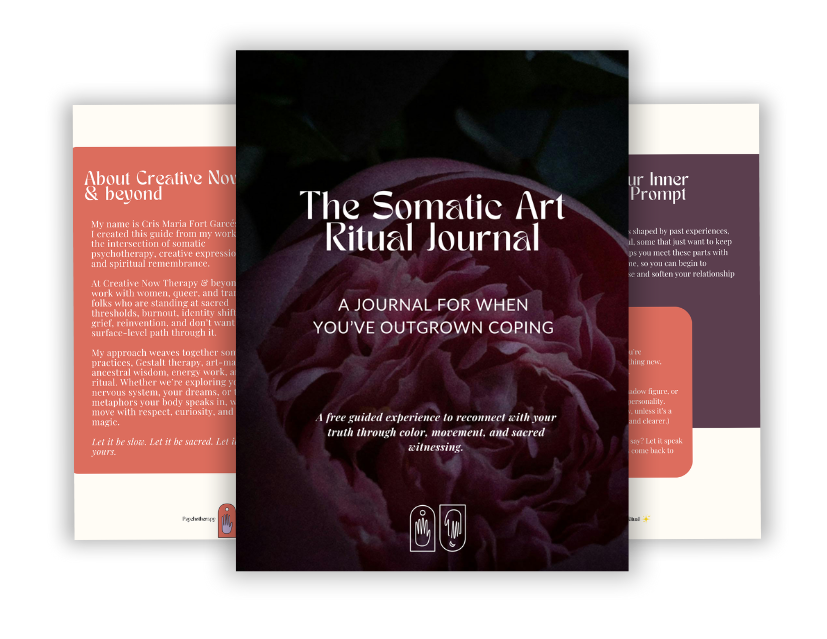
Three journal cover designs, centered dark floral cover titled “The Somatic Art Ritual Journal”
holistic life coach
By Cristina Maria Fort Garcés, LCAT, ATR-BC, CPC • October 13, 2026
A holistic life coach works with your whole self, body, mind, and soul. Discover what this means, how it differs from therapy, and if it's right for you.

Misty autumn field with birch trees, bare branches, and a few last orange leaves as fog closes in du
By Cristina Maria Fort Garcés, LCAT, ATR-BC, CPC • October 11, 2026
On descent, the scales, and finding the balance within
Lit candle on a table with tarot cards and a hand adjusting a pendulum, suggesting a mystical reading.
By Cristina Maria Fort Garcés, LCAT, ATR-BC, CPC • September 16, 2026
Spiritual guidance isn't about finding answers outside you. It's about remembering what's within. Support for deep feelers who have outgrown ordinary healing.
Dark abstract pattern of overlapping green and brown leaves with striped veins
By Cristina Maria Fort Garcés, LCAT, ATR-BC, CPC • September 10, 2026
A somatic guide to Virgo season: the new moon at 18 degrees, why your gut decides before your head does, and what distillation asks of you.

Woman in a white lace top sits by a window with eyes closed and hands clasped in prayer
By Cristina Maria Fort Garcés, LCAT, ATR-BC, CPC • September 9, 2026
Spiritual awakening isn't a glow-up. It's a dismantling. Learn what it really feels like, what triggers it, and how somatic support helps you move through.

Keychain with small metal charms beside a feather on a wooden surface
By Cristina Maria Fort Garcés, LCAT, ATR-BC, CPC • August 20, 2026
Shamanic healing is one of the oldest forms of soul-level support. Learn what it really is, what a session involves, and how it works with somatic therapy.